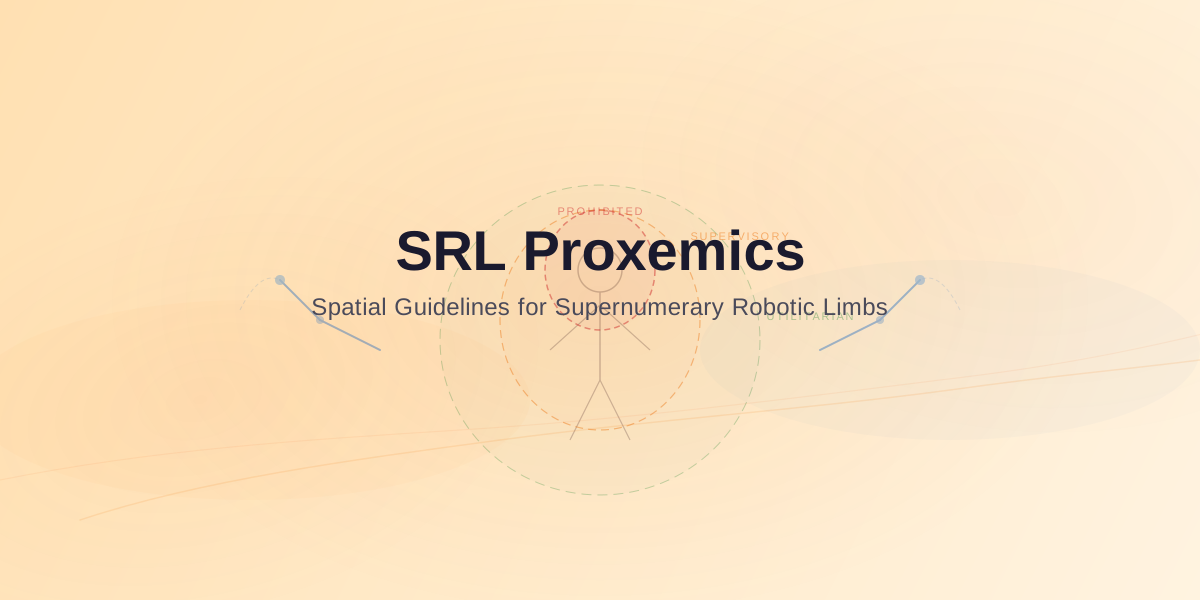
SRL Proxemics: Spatial Guidelines for Supernumerary Robotic Limbs in Near-Body Interactions
This project investigates how users negotiate spatial boundaries and autonomy with wearable supernumerary robotic limbs, proposing a zone- and segment-level proxemics framework grounded in perceived safety, trust, and embodiment.
Overview
SRL Proxemics investigates how people negotiate spatial boundaries and autonomy when wearable supernumerary robotic limbs (SRLs) operate within their intimate peripersonal space. Through a mixed-methods Wizard-of-Oz study (N=18), we elicit user-defined spatial policies for SRL behaviour near different body regions, measuring perceived safety, trust, embodiment, and physiological arousal under varying autonomy configurations. The resulting framework shows that perceived safety hinges not on higher autonomy, but on spatially calibrated, legible behaviours paired with clear coordination rules.
Vision
As SRLs evolve from laboratory prototypes to everyday wearable assistants, they will routinely move near the wearer's head, torso, and limbs. Unlike external robots that maintain social distance, body-mounted SRLs operate in zones where even small deviations can feel intrusive. Existing approaches treat autonomy as a single system-wide dial; SRL Proxemics reveals that users think in zones and segments — the head demands caution, the hands welcome collaboration, and the torso sits in between. By grounding spatial rules in real user experience rather than designer assumptions, we aim to make future SRLs feel safe, predictable, and trustworthy.
Key Findings
Body-Centric Trust Map
Participants converged on a clear taxonomy of sensitivity zones:
- Out-of-Bounds (Head & Face): 17/18 participants treated the face as a prohibited zone, maintaining at least an arm's length standoff.
- Supervisory Zone (Torso & Upper Arm): Conditionally accessible with clear purpose and user anticipation; preferred buffer of about a palm-width.
- Utilitarian Zone (Hands & Forearms): Accepted as the SRL's active workspace for handovers and manipulation.
- Elbow as Caution Boundary: 14/18 participants identified the elbow as a reflexive boundary marking the shift from utilitarian to protective perception.
Movement Preferences
- Pause-Move-Pause Rhythm: Participants preferred SRLs to pause at spatial boundaries before entering sensitive zones, providing time to prepare.
- Arc-Like Approach Paths: Diagonal or side entries were preferred over direct frontal intrusions, reducing startle responses.
- Non-Visual Cueing: Behind-body interactions were accepted when paired with gentle auditory or vibrotactile presence cues.
Autonomy and Trust
- Participant-defined spatial rules yielded higher perceived safety and capacity trust compared to a fully autonomous baseline.
- Skin conductance responses (SCR) revealed elevated arousal during frontal approaches and midline crossings, confirming the body-centric trust map.
Evaluation
An exploratory within-subjects study with 18 participants used a physical 7-DOF SRL prototype in a Wizard-of-Oz setup across two tasks (Comfort Zone handovers and Control Handover sorting). Data collection included think-aloud protocols, semi-structured interviews, Godspeed safety ratings, Trust Scale, Avatar Embodiment Questionnaire, and event-locked SCR. The combined analysis yielded the three-layer SRL Proxemics framework: embodied spatial boundaries, component-specific motion and autonomy preferences, and user-authored rules and delegation logics.
Applications
- Industrial Assistive Robotics: Designing safe motion envelopes for shoulder-mounted manipulators in manufacturing.
- Surgical Assistance: Informing spatial policies for robotic arms operating near a surgeon's body during procedures.
- Rehabilitation: Guiding wearable exoskeleton behaviour to maintain patient comfort and trust during therapy.
- Collaborative Telepresence: Setting spatial norms for remotely operated body-augmentation systems.
Team Members




Related Publications
SRL Proxemics: Spatial Guidelines for Supernumerary Robotic Limbs in Near-Body Interactions
H Zhou, CA Fan, Y Dong, S Takashita, M Inami, Z Sarsenbayeva, A Withana
Project Details
Timeline
Started: June 1, 2025
External Collaborators
- Chia-An Fan (University of Tokyo)
- Shuto Takashita (University of Tokyo)
- Masahiko Inami (University of Tokyo)