Integrating Force Sensing with Electro-Tactile Feedback in 3D Printed Haptic Interfaces
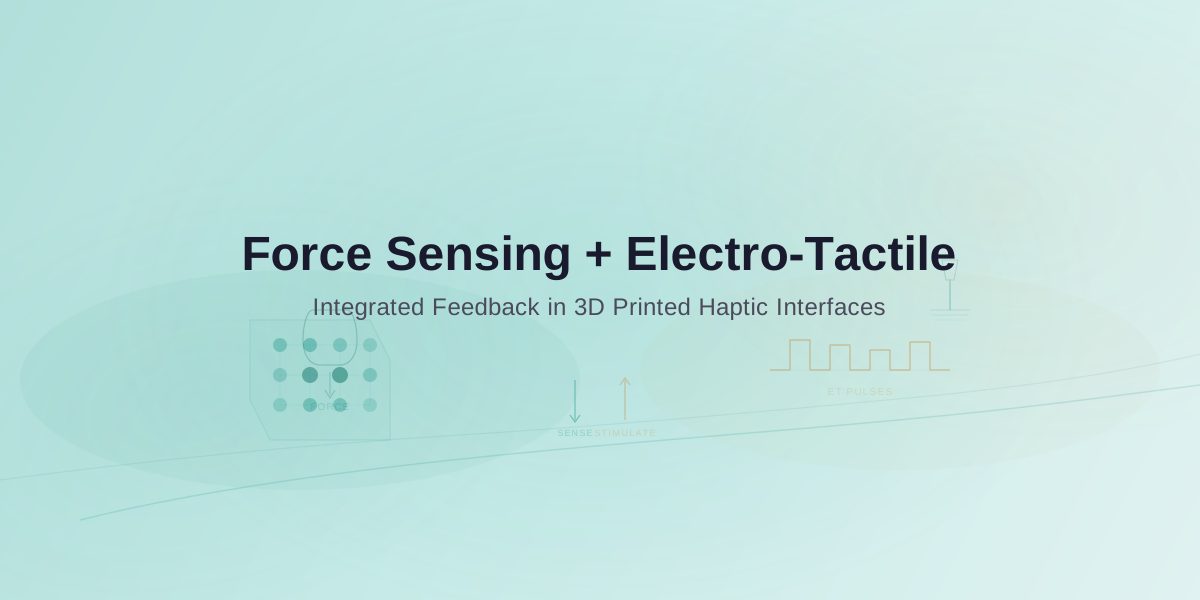
This project utilizes 3D printed modified surfaces as the electro-tactile electrode interface to sense applied force and deliver feedback simultaneously without the need for additional sensors
Overview
This project introduces a novel 3D-printed interface that can both sense touch force and deliver electro-tactile feedback using the same electrode surface. Traditional haptic systems separate sensing and actuation (producing feedback) into different components. Our work integrates both into a single, compact interface — enabling interactive surfaces that can feel and respond simultaneously. This approach simplifies hardware design while opening new possibilities for interactive objects, wearables, and virtual experiences.
Vision
Most interactive tactile systems rely on layered structures: sensors underneath and actuators on top. This makes devices bulky and difficult to fabricate. Our vision was to create a single multifunctional interface that:
- Detects how hard a user presses
- Delivers localized tactile feedback
- Can be fabricated using accessible 3D printing methods
- Supports rapid prototyping of interactive physical interfaces
By merging sensing and stimulation into one structure, we move toward thinner, smarter, and more seamless tactile systems.
What Makes This Different?
The key innovation is using a specially designed electrode structure that:
- Creates a variable contact with the skin to create proportional impedance change
- Can safely deliver controlled electro-tactile stimulation
- Is compatible with conductive 3D printing materials
- Functions as both input and output interface
This creates a bidirectional tactile surface — one that can "listen" to touch and "speak" back through electrical stimulation.
How It Works (In Simple Terms)
When a user presses the interface:
- The system detects changes caused by applied force.
- The force data is processed in real time.
- The same interface can then generate tactile feedback through controlled electrical pulses.
- Feedback can vary based on pressure, interaction patterns, or application logic.
Because sensing and stimulation share the same electrode geometry, the system remains compact and efficient.
Fabrication Approach
A major contribution of this work is demonstrating that such interfaces can be built using:
- Multi-material 3D printing
- Conductive and flexible materials
- Custom electrode geometries
- Digitally designed fabrication workflows
This makes the system accessible to researchers and designers working with digital fabrication tools.
Example Applications
This integrated interface can support a range of interaction scenarios:
Interactive Buttons
Buttons that detect how hard they are pressed and respond with corresponding tactile feedback.
Wearable Touch Surfaces
Thin patches that sense skin contact pressure and deliver programmable sensations.
Virtual Reality Controllers
Interfaces that simulate force or texture based on how users interact with virtual objects.
Smart Physical Objects
3D-printed objects that can sense grasping force and respond dynamically.
Evaluation
Through experimental validation, we demonstrated that:
- The interface can reliably detect applied force.
- It can simultaneously deliver electro-tactile stimulation.
- The system remains stable and responsive during bidirectional interaction.
- The fabrication approach is repeatable and scalable.
These findings show that multifunctional electro-tactile interfaces are feasible using accessible fabrication techniques.
Future Directions
We aim to expand this work by:
- Improving sensitivity and resolution of force detection
- Scaling to multi-electrode arrays
- Exploring wearable and soft robotics applications
- Conducting user studies on perceived realism and comfort